

Question – How Businesses Lose Insurance Claims ?
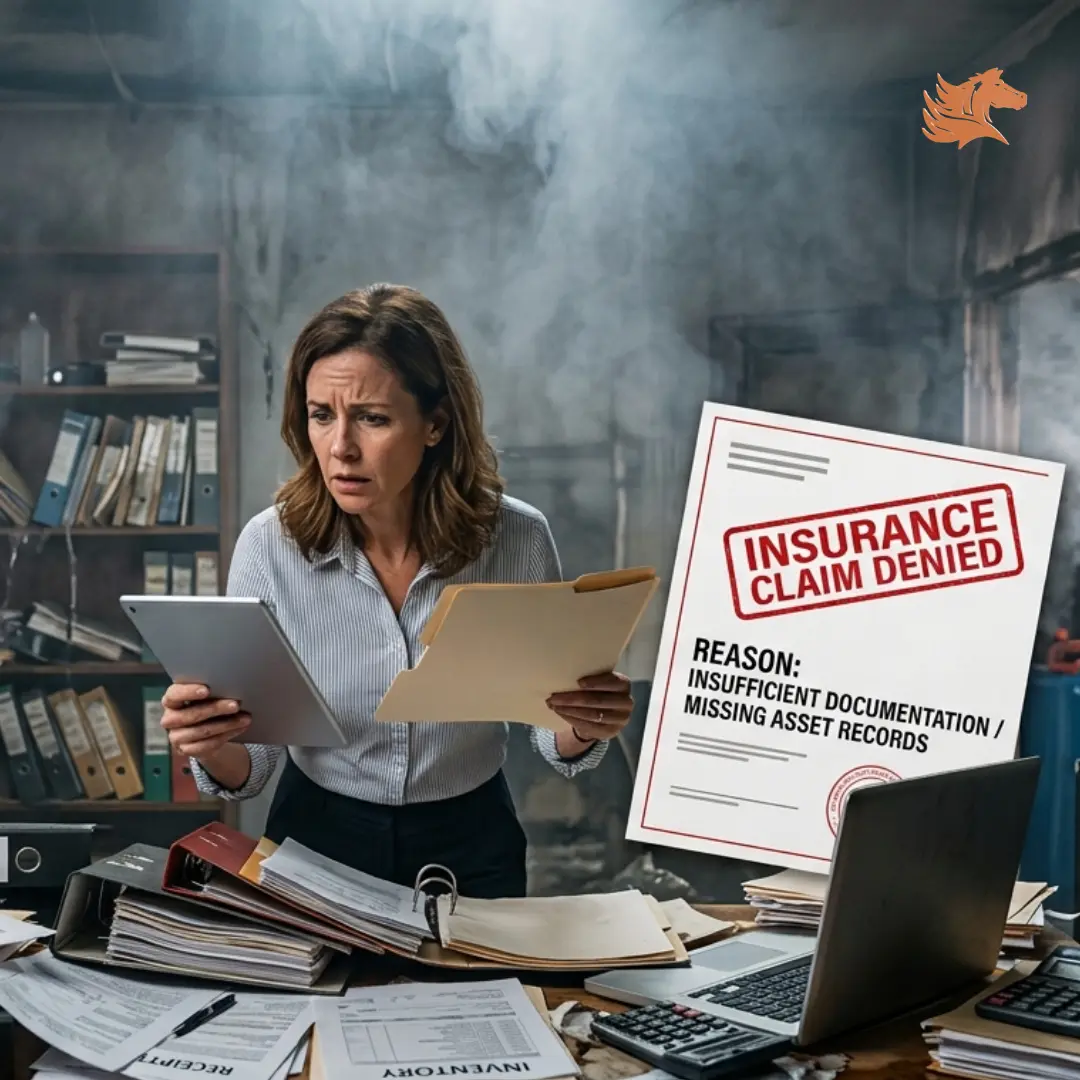
Quick answer: Businesses lose insurance claims because they lack coverage, but because they can’t produce proof of ownership, current valuation, and maintenance history fast enough when a claim is filed. Insurers now require exhaustive documentation, and incomplete records are consistently cited as one of the leading causes of claim denial, reduction, or delay.
Insurance is supposed to be the safety net that catches your business after a loss. But every year, businesses that pay their premiums on time discover — at the worst possible moment — that the safety net has a hole in it: their own records.
This isn’t a rare edge case. It’s a documented, recurring pattern across property, equipment, cyber, and liability insurance, and it’s becoming more common as insurers tighten what counts as acceptable proof.
- Why Insurance Claims Get Denied Over Documentation, Not Coverage
- The Data: How Often Poor Records Actually Cost Businesses
- The Three Pillars of Proof Every Insurer Requires
- Industry Scenarios Where Missing Records Sink a Claim
- Why Asset Records Break Down in the First Place
- How AssetPegasus Closes the Documentation Gap
- What Filing a Claim Looks Like With Centralized Records
- FAQ: Insurance Claims and Asset Records
Why Insurance Claims Get Denied Over Documentation, Not Coverage
Most business owners assume a denied claim means their policy didn’t cover the loss. Increasingly, that’s not what’s happening. Insurers today are asking for what industry analysts describe as “exhaustive proof” rather than “reasonable proof” — itemized inventories, sworn statements, maintenance logs, and independent valuations, not just a description of what happened. Commercial insurers are demanding more extensive documentation than in previous years, and inadequate documentation has become one of the leading reasons claims stall or are partially denied.
The pattern shows up across policy types. If a business can’t supply supporting evidence such as invoices, repair estimates, independent assessments, or detailed loss reports, insurers may reject the claim for insufficient proof of loss. Incomplete records or missing evidence — receipts, photos, incident reports — are a standalone, commonly cited reason for claim rejection. This is how Businesses Lose Insurance Claims.
This is the exact failure point AssetPegasus is built to close: centralizing the records insurers ask for, before you ever need them.
The Data: How Often Poor Records Actually Cost Businesses
The numbers behind this problem are larger than most business owners expect:
- Roughly a quarter of insurance claim disputes stem from a lack of proper evidence, underscoring how much documentation quality affects outcomes.
- Property insurance claims are frequently denied specifically due to incomplete documentation, based on industry-wide claim analysis.
- In one manufacturing case, an insurer denied a six-figure equipment and inventory damage claim outright over the absence of an independent valuation and a licensed repair estimate — not a coverage dispute.
- As businesses add equipment, inventory, or locations over time, outdated records routinely lead to underinsurance and reduced claim payouts even when a policy is technically active.
- In one case, a business couldn’t prove the value of stolen inventory because records weren’t organized, and the insurer limited the payout to a minimal estimated value.
Even in healthcare, where documentation requirements are the strictest, the same theme repeats: a large share of providers point to inaccurate or incomplete records at the point of intake as a primary driver of claim denials. The mechanism is identical whether it’s a hospital billing system or a warehouse’s equipment inventory — the claim is only as strong as the record behind it.
The Three Pillars of Proof Every Insurer Requires
Regardless of industry or policy type, insurers evaluate claims against three documentation pillars. Missing any one of them weakens — or kills — the claim.
1. Proof of ownership and existence
Purchase invoices, serial numbers, asset tags, and purchase orders that confirm the asset existed and belonged to your business.
2. Accurate, current valuation
Purchase price, depreciation schedule, and current book value. Without this, insurers apply their own — usually lower — estimate, or reject the claim as unsubstantiated.
3. Evidence of proper maintenance and care
Most commercial policies include due-diligence language. If a covered event — such as fire — occurs and a preventable failure (like a poorly maintained alarm system) contributed to the loss, insurers can refuse payment on the basis of inadequate maintenance. If you can’t produce a maintenance log, the insurer can argue negligence caused the loss, not the insured event.
Miss any of these three, and even a legitimate, fully covered loss can result in a denial, delay, or reduced settlement.
Industry Scenarios Where Missing Records Sink a Claim
Manufacturing. A production line asset is damaged. The insurer requests service history to confirm it operated within manufacturer guidelines. The log lived in a technician’s notebook, last updated eight months earlier. Settlement reduced.
Healthcare. A hospital submits a claim for a damaged diagnostic device. Compliance-heavy documentation standards mean the insurer wants calibration and service records on file immediately. Nobody can locate them fast enough, and patient-care equipment sits unreplaced for months.
Construction. Heavy equipment moves between job sites constantly. When a piece is stolen, the business can’t confirm which site it was last assigned to, let alone produce a current valuation. The insurer treats the claim as unsubstantiated.
Hospitality. A multi-location restaurant group can’t quickly determine which kitchen or HVAC equipment belonged to which property, when it was purchased, or its depreciated value after a fire. The claim drags on for months.
IT and cybersecurity. A breach traces back to a laptop nobody can positively confirm as company-issued. Cyber insurance claims are commonly denied when insurers determine that adequate security measures — including proper asset and device controls — weren’t demonstrably in place.
Different industries, same root failure: the asset record wasn’t centralized, current, or retrievable on demand.
Why Asset Records Break Down in the First Place
Ask most IT, operations, or facilities leaders where their asset records live, and the honest answer is “a few different places.” A spreadsheet for hardware. An email folder for warranties. A binder for insurance policies. Nothing at all for machinery or software licenses.
This fragmentation is the direct cause of claim failure:
- Records go stale the moment someone forgets to log a repair, relocation, or replacement.
- No single person owns insurance documentation, so it’s the first thing lost when an employee leaves.
- Multi-location businesses can’t reconcile which asset belongs where — especially equipment that physically moves between sites.
- When a claim happens, someone has to reconstruct the history under time pressure, exactly when accuracy matters most.
Regulatory and documentation expectations for small businesses have risen substantially, and annual coverage reviews with organized documentation systems are now considered baseline risk management, not optional best practice. Spreadsheets and email threads simply weren’t built to meet that bar.
How AssetPegasus Closes the Documentation Gap
AssetPegasus centralizes every hardware, software, and machinery record — the exact information insurers request — into one searchable platform.
A single, centralized asset record. Every asset carries its full profile: purchase date, cost, serial number, assigned location, department, and current status. No digging through inboxes to reconstruct what was bought, when, and by whom.
Built-in insurance and contract tracking. Policy details, vendor contracts, and service agreements attach directly to the specific asset they cover — so the policy number and coverage details are already linked when a claim needs to be filed.
Maintenance and warranty history that proves due diligence. Automated maintenance scheduling and proactive alerts build a timestamped record proving equipment was properly cared for — precisely what insurers request before honoring equipment-failure or damage claims.
Full lifecycle and audit trail. Every status change, from purchase through retirement or disposal, is logged automatically, so “what happened to this asset and when” is a report, not a guess.
Real-time, multi-location visibility. For businesses managing equipment across job sites, restaurant locations, or healthcare facilities, AssetPegasus shows exactly which asset is assigned where at any given moment.
Claim-ready reporting. Generate a clean valuation, ownership, and maintenance-history report in minutes — ready to hand directly to an adjuster.
GDPR & HIPAA-aligned recordkeeping. For regulated industries, the same audit trail that supports compliance reporting also supports insurance and legal documentation requirements.
What Filing a Claim Looks Like With Centralized Records
- The incident happens — damage, theft, or loss of an asset.
- Pull the asset record — ownership and valuation are already documented.
- Attach the linked insurance policy — no searching, because it’s already connected to the asset.
- Export a claim-ready report — clean, audit-ready documentation for the adjuster.
- The claim moves faster — because the questions insurers ask are already answered.
Compare that to the alternative: days or weeks reconstructing history from memory and outdated spreadsheets, while the claim — and the cash flow it represents — sits unresolved.
| End – How Businesses Lose Insurance Claims Due to Missing Asset Records
FAQ
Protect What You’ve Already Paid to Insure
You’re already paying premiums to protect your hardware, machinery, and equipment. AssetPegasus makes sure that investment actually pays off when a claim needs to be filed — with centralized records, linked insurance details, complete maintenance history, and reports ready in minutes, not weeks.
Start your 1 Month free trial — no credit card required.
📜
- Preventative Maintenance for Critical Healthcare Equipment: Avoiding ICU Downtime
- Multi-Plant Equipment Management: End the Chaos
- Medical Equipment Lifecycle Management: A HIPAA-Compliant Guide to Preventing Lost Assets
- How Poor Asset Management Increases Operating Costs
- How Businesses Lose Insurance Claims Due to Missing Asset Records