
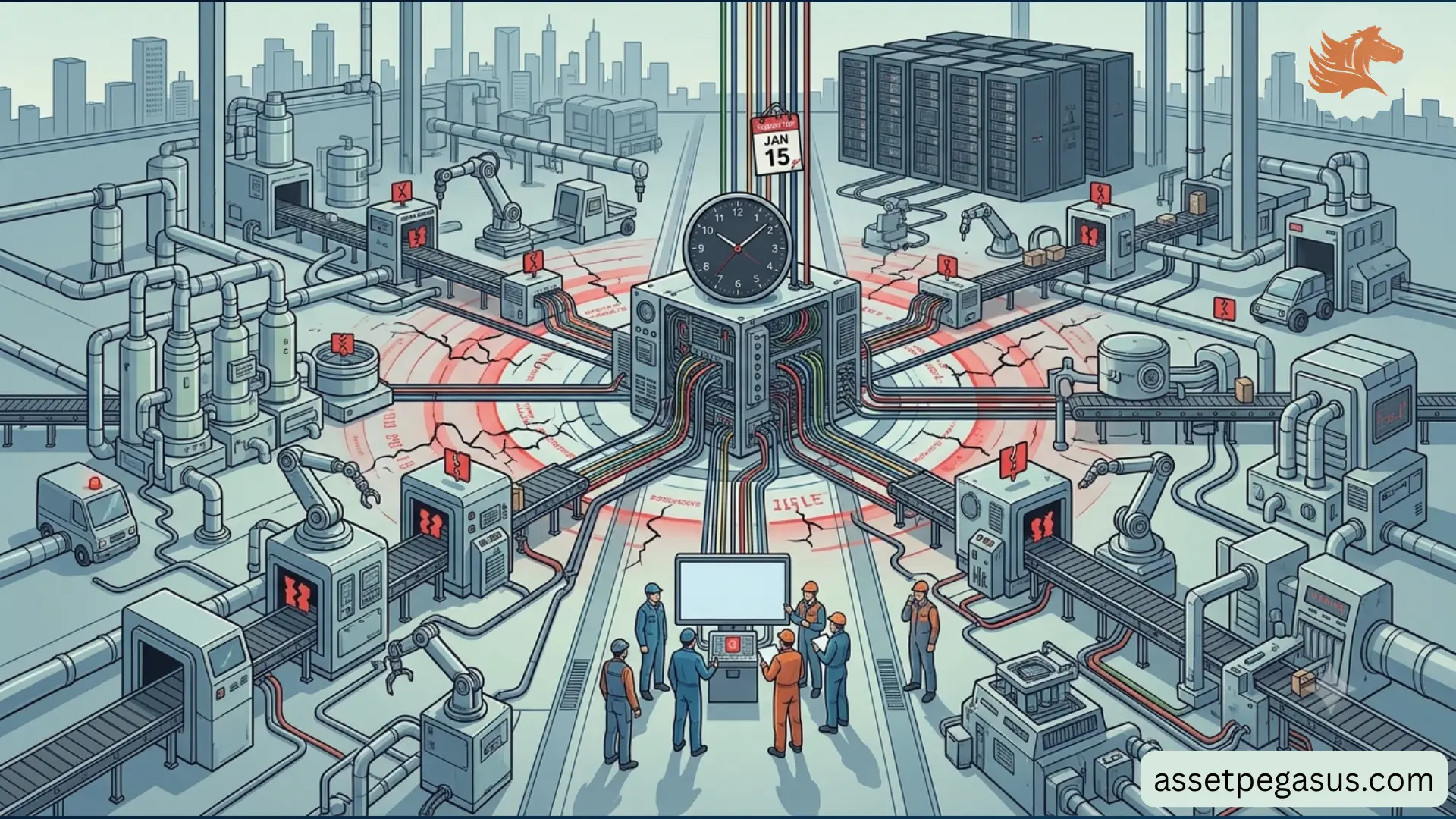
One Forgotten Service Date Can Shut Down an Entire Factory, It rarely starts with an explosion or a dramatic failure. It starts with something almost boring: a service date that quietly passes without anyone noticing.
A bearing that should have been inspected. A hydraulic line that needed a scheduled check. A filter that was due for replacement three weeks ago. On its own, each of these looks like a minor, forgettable task. But in a factory, machines don’t operate in isolation — they operate as a chain. And chains don’t care how small the missing link is.
⚙️ How a Small Miss Becomes a Big Shutdown
Here’s the pattern that plays out in facilities everywhere, again and again:
A piece of equipment misses a scheduled service date because nobody was tracking it — or the reminder lived in someone’s inbox and got buried.
🏭 The machine keeps running, because on the surface, everything still looks fine.
🔧 Small wear turns into a real fault — vibration, overheating, a part failing under load.
♻️ That machine is connected to a production line, so when it goes down, the whole line stops with it.
📅 Depending on the facility, that one line might represent a third, a half, or all of daily output.
What began as one missed calendar entry ends as a full production stoppage, an emergency repair crew, expedited parts shipping, and a factory floor standing idle while the clock — and the payroll — keeps running.
❌ Why This Keeps Happening
It’s tempting to treat this as a rare, unlucky event. It isn’t. It’s a structural problem that shows up wherever maintenance scheduling depends on manual tracking:
📝 Spreadsheets don’t send alerts. A due date sitting in a cell doesn’t tell anyone it’s approaching — someone has to remember to check it.
🛠️ Maintenance knowledge lives in people’s heads. When the technician who “just knows” the service schedule is out sick, on vacation, or leaves the company, that knowledge leaves too.
📌 Multiple sites make it worse. A single facility might manage service dates informally and get away with it. Multiple sites managing dozens of machines each, with no centralized system, turns “informal” into “impossible.”
There’s no early warning — only a deadline. By the time someone notices a service date was missed, it’s often already overdue, not upcoming.
Manufacturing runs on machines that are expected to work every single day. The moment maintenance becomes reactive instead of proactive, downtime stops being a possibility and becomes a matter of when.

⏳ The Real Cost of Unplanned Downtime
Unplanned downtime is one of the most expensive things that can happen on a factory floor, and the cost isn’t limited to the repair itself:
📅 Lost production — every hour the line is down is output that doesn’t get made and can’t always be recovered later.
🧑🏭 Emergency labor and parts — rush repairs cost more than scheduled ones, often significantly more.
🚚 Missed delivery commitments — downstream customers and contracts don’t pause because a machine did.
🛡️ Safety risk — equipment that fails unexpectedly is more likely to fail in ways that put workers at risk, not just output.
🔬 Compounding failures — one machine running under strain can put additional load on connected equipment, turning one problem into several.
None of this is hypothetical. It’s the direct, predictable result of maintenance schedules that exist somewhere other than a system built to track them.
💡What Prevention Actually Looks Like
The fix isn’t more people checking spreadsheets more often — it’s removing the dependency on memory altogether. A proper preventive maintenance system should:
🎯 Track every machine’s full service history and upcoming schedule in one place.
🔄 Send proactive alerts before a service date arrives, not just log it after the fact.
📅 Make maintenance schedules visible across teams and shifts, not owned by one person.
🖥️ Cover every facility from a single dashboard, so multi-site operations don’t rely on local memory.
Tie maintenance data to warranty and insurance status, so a missed service date doesn’t also quietly void coverage
This is exactly the gap AssetPegasus was built to close. Instead of service dates living in someone’s calendar or a shared spreadsheet nobody checks, AssetPegasus centralizes maintenance scheduling for every machine, across every location, with automated alerts before a date is missed — not after a line goes down.
For manufacturing and industrial operations managing production machinery, tools, and equipment across factory floors and multiple facilities, that difference is the line between a scheduled five-minute service check and an unscheduled five hour shutdown.
✅ The Takeaway
A factory doesn’t go down because of one catastrophic failure. It goes down because one ordinary service date, on one ordinary machine, was never tracked properly — and nobody found out until it was too late to prevent it.
The good news is that this is one of the most preventable risks in manufacturing. It doesn’t require new equipment or bigger maintenance teams. It requires visibility — knowing, at all times, exactly what’s due, on what machine, at which facility.
❓FAQ
📜
Don’t let a missed date become a missed shift. Start your 1 month free trial of AssetPegasus and put every piece of machinery, every service date, and every facility on one dashboard — before the next forgotten date turns into the next shutdown.
- Preventative Maintenance for Critical Healthcare Equipment: Avoiding ICU Downtime
- Multi-Plant Equipment Management: End the Chaos
- Medical Equipment Lifecycle Management: A HIPAA-Compliant Guide to Preventing Lost Assets
- How Poor Asset Management Increases Operating Costs
- How Businesses Lose Insurance Claims Due to Missing Asset Records